2 / 3

VARIOUS SPINIFEX ARTISTS (COLLABORATIVE)
Kungkarangkalpa19-389 (2019)
Acrylic on Linen
Kungkarangkalpa | 19-389
Acrylic on Linen
200 x 290cm | 78.74 x 114.17in
ENQUIRE
This painting Kungkarangkalpa or better known as Seven Sisters has been painted by seven Spinifex women; Ngalpingka Simms, Kanta Donnegan, Lorraine Davies, Tracey Simms, Dora Parker, Sophia Brown and Katie Brown.
his is a womens Tjukurpa which traverses vast tracts of Spinifex country and beyond. In fact this is such a significant story that the womens tracks and creation sites are found all over Australia. The women here have painted country from Patjar in the north of the Ngaanyatjarra Lands of Western Australia following a songline travelling south into southern Spinifex Country.
The women ere camped at a site called Tika-tika and Kalumara just south of Patjarr. Many of the rock holes in the surrounding country were made by these ancestral beings and they were digging for food and water.The women are depicted here sitting down by the semi circular motifs and their foot prints lead to the rock holes.
Then they headed south of Warburton to the sites near Snake Well called Tjawl-tjawl and Piyul. All the while the women were trying to evade the pursuit of the lustful old man Wati Nyiiru. The man is sitting by his fire inside his windbreak with his spear and spear thrower. He has been sneaky and built several yuu’s (shelters from trees) to give him cover as he spies on the women. He desperately wants the elder sister to be his wife, but she doesn’t want the old man.
The women keep moving heading to Uturi, to get away from him but he still follows them. They pass by Pur-purnya country which holds the dangerous men ’s story. The two serpent beings a father and son have been out on initiation business. These men are from Pukara.
The women continue south into the heartland of Spinifex country making numerous rockholes and performing sacred rituals along the way. At Kuru Ala the man catches one of the women and cause her injury but she escapes to the cave and the care of her sisters who spend time healing her.
Then the pass through Tjuntjunya, Kapi Piti Kutjara, Tjalkinya, Kanka, Wangulpinya and Pirapi.
Although each women knows this major Tjukurpa, they are bound by cultural protocol and custodial responsibility as to which country they can depict. As the country and Tjukurpa unfolds during the creation of a major work like this, the women ‘sing the place’ into reality. Traditional inma (singing and dancing) is triggered as the depictions of places, that the women may not have physically seen for many years, begin to manifest onto the canvas.
his is a womens Tjukurpa which traverses vast tracts of Spinifex country and beyond. In fact this is such a significant story that the womens tracks and creation sites are found all over Australia. The women here have painted country from Patjar in the north of the Ngaanyatjarra... Read More
Appeared in this exhibition


VARIOUS SPINIFEX ARTISTS (COLLABORATIVE)
Minyma Tjuta19-323 (2019)
Acrylic on Linen
Minyma Tjuta | 19-323
Acrylic on Linen
200 x 290cm | 78.74 x 114.17in
ENQUIRE
Seven women: Dora Parker, Ivy Laidlaw, Myrtle Pennington, Ngalpingka Simms, Tracey Simms, Sophia Brown and Kanta Donnegan, have painted this Seven Sisters story, a major Western Desert Tjukurpa that traverses Spinifex Country at numerous sites.
The story pertains to the creaon of the landscape and details the women’s travels as they sing inma, collect bush foods and pursue a giant python, as they are in turn pursued closely by the lustful wati Nyiru (man). Specific events in this story where the women intersect with Nyiru, form geographic and culturally important sites, many which are for women only.
At Tuntunya rockhole which is Kanta Donnegan’s country she tells the story of the sisters painting their nipples getting ready for ceremony. The word for nipple is tuntun in Spinifex language. Sophia Brown painted a site called Kulyuru her grandfather’s place, where the women chase the python who forms a large hole in the rock as he escapes. A tree overlooking the canyon at Kulyuru is Nyiru, never far from the sisters.
The python winds its way across the landscape of Kulyuru creating a large creek bed. At Kuru Ala in the north of Spinifex country one of the women is grabbed by Nyiru, she is later healed by her sisters in the cave. The women’s journey and sites travelled are represented by the many rockholes or roundels in this painting.
Wati Nyiru is represented by his camp and spear and can be seen in numerous places across this canvas. Ivy Laidlaw has painted the women sitting in their camp, with Wati Nyiru waiting nearby, with his spear and spear thrower. Dora Parker has painted the site of Purpurnya. Ngalpingka and Tracey Simms, mother and daughter, have worked together to paint Wayiyul country close to Karilywara (Patjarr) in the Ngaanyatjarra Lands of Western Australia.
It is where Ngalpingka was born and grew up living a traditional nomadic life with her family. She knows this country intimately, in both a physical and spiritual sense. The seven sisters camped at Wayiyul and Nyiru has been stalking them, camping some distance from where they stop and hiding behind his windbreak, poking his head over to take a look.
The women are disturbed by his constant pursuing of them and quickly take off to camp away from him. They travel to (roundels are the sites) Karilywara, Miputjara, Tikatika, Wanarn and Yalara.
The younger women who worked on this painting continue to learn the details of this extensive story under the guidance of their senior close relatives. These women will be the bearers of this story for the following generations and express the story through painting and other contemporary art forms. The younger artists are; Tracey Simms, Dora Parker, and Sophia Brown.
The story pertains to the creaon of the landscape and details the women’s travels as they sing inma, collect bush foods and pursue a giant python, as they are in turn pursued closely by the lustful wati Nyiru (man). Specific events in this story... Read More
Appeared in these exhibitions

VARIOUS SPINIFEX ARTISTS (COLLABORATIVE)
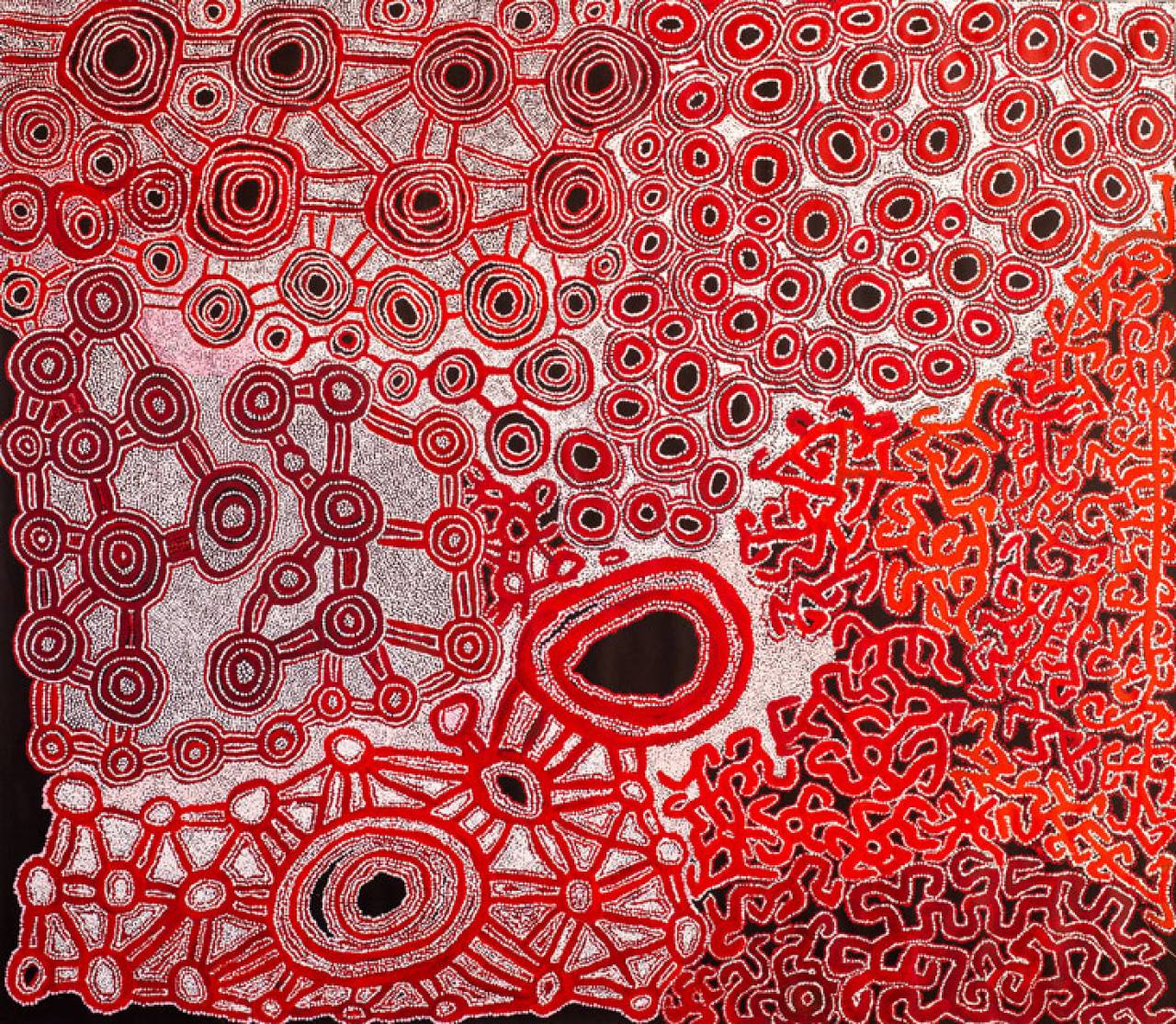
Pila Nguru18-400 (2018)
Acrylic on Linen
Pila Nguru | 18-400
Acrylic on Linen
200 x 230cm | 78.74 x 90.55in
ENQUIRE
Six senior Spinifex men have collaborated to create this painting that gives us a depiction of Pila Nguru - from Spinifex Country. The Men have connection to a swathe of significant sites that inter relate to one another through story, song and cultural authority. There is birthright and paternal links that govern who can depict which sites but the men know the others country and the Tjukurpa associated within it intimately. It is this intimacy, this complete knowledge of one another’s place in Country and Culture that allows the men to join in such a way. Here they give us a glimpse into a way of seeing the world, a depiction of birth and creation from an intrinsically linked posion where the creaon of country is the story and the song.
Roy Underwood takes us through the monumental sand ridges of Miramiratjara as its being guarded by a powerful Wanampi (Water Serpent) who travels through the ground appearing when necessary. Fred Grant depicts the abundance of sites, the interlaced travelling tracks that carried him to this place, to Pirapi from the beginning, wandering through Country with meaning. Ned Grant follows the paths of the wata tree roots) and takes us deep underground within the labyrinth of twists and turns, created by the first beings to surface through the Ngalta (Currajong) that holds the life affirming water for travelling through this arid landscape. Ian Rictor places Kamanti, the site representing the Two Men who made this their home on the journey of Creation. Lennard Walker takes on the journey north to his home of Kulyuru where the Minyma Tjuta created the landscape and Byron Brooks guides us to the east as we watch country associated with his childhood unfold.
This multitude of sites, of country, of fauna and flora was all created as the first beings moved though. Traversing and shaping the landscape all at once, telling the story, the moral narrative and physical reminders of their power and presence that people still live by today.
Provenance
Spinifex Arts ProjectReDot Fine Art Gallery - Singapore
Private Collection - Queensland
Appeared in this exhibition