![Australian Indigenous (Aboriginal and Torres Strait Islander) artwork by KUNMANARA PATJU PRESLEY of Spinifex Artists. The title is Wati Nyir-Nyir. [22-27] (Acrylic on Linen)](https://media.redotgallery.com/stockroom/gallery/w/artwork/p/wati-nyir-nyir-6367-MEDIUM-1.jpg)
KUNMANARA PATJU PRESLEY (dec)
Wati Nyir-Nyir
22-27 (2022)
Acrylic on Linen
200 x 137cm | 78.74 x 53.94in
Spinifex Artists
ENQUIRE
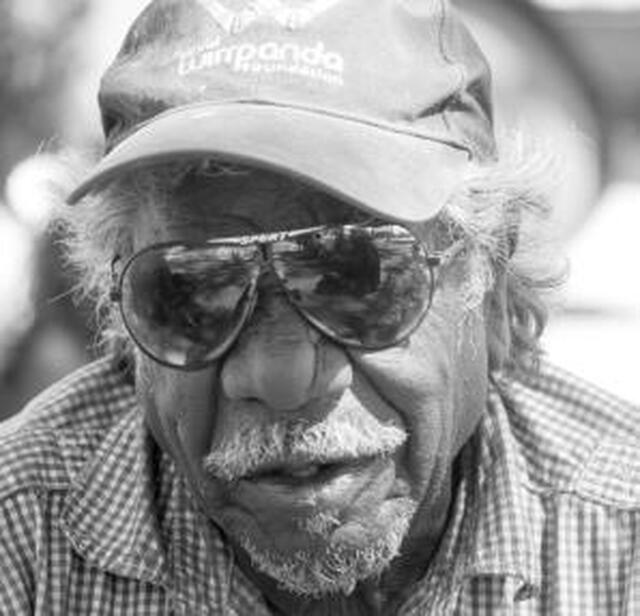
Patju Presley (Kunmanara Presley), a senior Pitjantjatjara elder and lawman from the remote Spinifex community in Tjuntjuntjara, Western Australia, was one of the leading voices in contemporary Australian Indigenous art until his passing in 2025.
Born in 1945 at the sacred site of Itaratjara, nestled deep within the Great Victoria Desert, Kunmanara (Patju) Presley embodied the nomadic essence of his Pila Nguru (Spinifex People) forebears, traversing ancient Tjukurpa tracks that weave together sacred places, sources of food and water, and deep ancestral stories.
Presley's paintings celebrate the sacred Spinifex homelands from which he was once exiled.
As a youth, Presley and his family were displaced by British nuclear testing in South Australia.
Throughout the 1950s, with Australian government approval, the UK detonated seven atomic bombs and conducted hundreds of smaller weapons-related tests at Maralinga, a prohibited military zone within the Great Victoria Desert.
Nuclear blasts and radioactive fallout forced local Aangu (Indigenous Pitjantjatjara and Yankunytjatjara communities) from their ancestral country, dispossessing them from their homelands for decades.
From a vantage point high in the Mann Ranges, Presley as a child witnessed what he called "the big smoke": a mushroom cloud that upended his existence as a desert nomad and shaped a new life.
His family migrated first to the Warburton Mission, then trekked more than 500 kilometres by foot to Ernabella (Pukatja), where Presley acquired Pitjantjatjara literacy and the Christian gospel.
Trained as a preacher, he served as both a community pastor as well as a traditional Indigenous lawman and practitioner of inma (ceremonial song and dance), inhabiting both religious traditions with ease.
Presley began painting at the Irrunytju art center in the early-2000s, amid an epochal surge of new Aangu artists.
He later joined the Spinifex Arts Project at Tjuntjuntjara, igniting his art practice with extraordinary assurance and gaining international recognition.
Presley's paintings, deploy bold color and shimmering veils of rhythmic dotting to render epic Tjukurpa (creation narratives) that depict the primordial journeys of Kalaya (emus), Wati Kutjara (water snake men), and Wati Ngintaka (an ancestral monitor lizard).
Vibrant hues in pointillistic cascades evoke the spiritual richness of his northern Spinifex homeland, capturing the calm harmonies of desert sandhills, rockholes with their life-giving water basins, and the totemic ancestral tracks that bind the Pila Nguru (Spinifex People) to their land.
Presley's works function both as abstract maps and deeply spiritual testimonial statements, balancing dignity and gravitas with dynamic movement.
Drawing from his experience of nuclear displacement, personal reinvention, and subsequent recovery of native tradition, his work celebrates the reclamation of Spinifex homelands and the fortitude and resilience of the Pila Nguru.
Presley's enduring brilliance lies in his ability to bridge ancient Tjukurpa with contemporary expression, a galvanizing interplay of the abstract and the ancestral, confirming the vitality of Indigenous storytelling.
Although Presley's painting practice was relatively short-lived, its impact remains profound, cementing his legacy as a masterful chronicler of Spinifex Country and its metaphysical potency.
Featured in landmark exhibitions including Sun & Shadow: Art of the Spinifex People (2023), the NGV Triennial, Tarnanthi Festival, and In the Beginning at the Kluge-Ruhe Aboriginal Art Collection (USA, 2025–6), Presley's paintings are highly sought after and grace prestigious, significant public and private collections, reflecting his growing international stature.
In 2023 he was also commissioned to produce a monumental 300 x 200cm canvas, entitled Wakura, for the Embassy of Australia, in Washington DC, an undertaking he was immensely proud of.
The artwork was part of a series of six new site-specific commissions by various Australian artists for the embassy.
.Patju Presley (Kunmanara Presley), a senior Pitjantjatjara elder and lawman from the remote Spinifex community in Tjuntjuntjara, Western Australia, was one of the leading voices in contemporary Australian Indigenous art until his passing in 2025.
Born in 1945 at the sacred site of Itaratjara, nestled deep within the Great Victoria Desert, Kunmanara (Patju) Presley embodied the nomadic essence of his Pila Nguru (Spinifex People) forebears, traversing ancient Tjukurpa tracks that weave together sacred places, sources of food and water, and deep ancestral stories.
Presley's paintings celebrate the sacred Spinifex homelands from which he was once exiled.
As a youth, Presley and his family were displaced by British nuclear testing in South Australia.
Throughout the 1950s, with Australian government approval, the UK detonated seven atomic bombs and conducted hundreds of smaller weapons-related tests at Maralinga, a prohibited military zone within the Great Victoria Desert.
Nuclear blasts and radioactive fallout forced local Aangu (Indigenous Pitjantjatjara and Yankunytjatjara communities) from their ancestral country, dispossessing them from their homelands for decades.
From a vantage point high in the Mann Ranges, Presley as a child witnessed what he called "the big smoke": a mushroom cloud that upended his existence as a desert nomad and shaped a new life.
His family migrated first to the Warburton Mission, then trekked more than 500 kilometres by foot to Ernabella (Pukatja), where Presley acquired Pitjantjatjara literacy and the Christian gospel.
Trained as a preacher, he served as both a community pastor as well as a traditional Indigenous lawman and practitioner of inma (ceremonial song and dance), inhabiting both religious traditions with ease.
Presley began painting at the Irrunytju art center in the early-2000s, amid an epochal surge of new Aangu artists.
He later joined the Spinifex Arts Project at Tjuntjuntjara, igniting his art practice with extraordinary assurance and gaining international recognition.
Presley's paintings, deploy bold color and shimmering veils of rhythmic dotting to render epic Tjukurpa (creation narratives) that depict the primordial journeys of Kalaya (emus), Wati Kutjara (water snake men), and Wati Ngintaka (an ancestral monitor lizard).
Vibrant hues in pointillistic cascades evoke the spiritual richness of his northern Spinifex homeland, capturing the calm harmonies of desert sandhills, rockholes with their life-giving water basins, and the totemic ancestral tracks that bind the Pila Nguru (Spinifex People) to their land.
Presley's works function both as abstract maps and deeply spiritual testimonial statements, balancing dignity and gravitas with dynamic movement.
Drawing from his experience of nuclear displacement, personal reinvention, and subsequent recovery of native tradition, his work celebrates the reclamation of Spinifex homelands and the fortitude and resilience of the Pila Nguru.
Presley's enduring brilliance lies in his ability to bridge ancient Tjukurpa with contemporary expression, a galvanizing interplay of the abstract and the ancestral, confirming the vitality of Indigenous storytelling.
Although Presley's painting practice was relatively short-lived, its impact remains profound, cementing his legacy as a masterful chronicler of Spinifex Country and its metaphysical potency.
Featured in landmark exhibitions including Sun & Shadow: Art of the Spinifex People (2023), the NGV Triennial, Tarnanthi Festival, and In the Beginning at the Kluge-Ruhe Aboriginal Art Collection (USA, 2025–6), Presley's paintings are highly sought after and grace prestigious, significant public and private collections, reflecting his growing international stature.
In 2023 he was also commissioned to produce a monumental 300 x 200cm canvas, entitled Wakura, for the Embassy of Australia, in Washington DC, an undertaking he was immensely proud of.
The artwork was part of a series of six new site-specific commissions by various Australian artists for the embassy.
.